Hey folks, let’s cut to the chase if you’re in the machining game—especially with multi-spindle work, you’ve probably stared at that “motor power” spec on your double-spindle CNC lathe and wondered, “Does this number actually matter, or is it just marketing fluff?” As someone who’s spent 12+ years selling double-spindle CNC lathes, I’m here to break this down like I would with a shop owner leaning over my workbench at 7 a.m., before the first part even spools. Double-spindle CNC Lathe

First, let’s ground this in what a double-spindle lathe does that makes its motors so critical. Unlike a single-spindle, which cycles through loading, turning, and unloading one part at a time, a double-spindle runs both sides at once—one spindle is cutting raw stock, the other is unloading the finished part and loading new blank, right? That overlap means the motors aren’t just spinning a chuck; they’re handling two full machining operations in parallel, and if one side’s motor is underpowered, you’re not just slowing that side down—you’re bottlenecking the entire machine. I’ve seen guys try to save a few bucks on a lathe with a 7.5kW spindle motor for turning a 316 stainless steel shaft, and within three weeks, they’re burning out windings because every heavy cut on both sides was overloading that weak link.
Now, let’s talk spindle motor power specifically, because that’s the big one everyone fixates on. I’m not talking about the servo motor that moves the tool turret—though that matters too, but it’s secondary. Spindle motor power is what drives the chuck’s rotation through the cut. For double-spindles, we usually spec spindle motors between 10kW and 22kW, depending on what the machine’s built for. Let’s break that use case down: if you’re doing light work—aluminum parts for consumer electronics, small brass fittings, that sort of thing—10 to 15kW is more than enough. But if you’re running hardened steel, titanium, or thick wall stock? You need 18kW minimum, and up to 22kW for high-production stuff where you’re taking deep cuts on both spindles at the same time. Here’s the real world example: last year, a customer was making hydraulic valve bodies from 4140 steel, 2-inch diameter blanks. They had a competitor’s double-spindle with two 12kW spindles. They were getting 15 parts an hour, and every other day a spindle would trip a thermal overload mid-cut, forcing a 20-minute downtime. They switched to our machines with 18kW spindles, and they’re now at 27 parts an hour, zero overload trips. That’s not a number out of a catalog—that’s actual floor time saving.
Wait, but what about torque? A lot of guys mix power (kW) and torque (lb-ft) like they’re the same thing, and that’s a mistake. Torque is what actually does the cutting—power is just how fast you can sustain that torque over time. A 15kW spindle might have more peak torque than a 18kW if it’s tuned wrong for high RPM, but for continuous heavy cuts, the higher kW motor will outlast the smaller one. On double-spindles, this is extra important because when both spindles are under load, the total demand adds up. I had a customer a few months back who tried to run two aluminum jobs: one was a thin-walled cup, the other was a thick bushing. He was running the 15kW spindles, and when he took a 0.2-inch depth cut on both at once, the torque dropped, the part had a rough finish, and the spindle wouldn’t hold speed. Crank up to 18kW, same cut, same time, and the finish was 10 times smoother, no speed drop. That’s the power difference right there.
Now, the other motor everyone ignores: the sub-spindle? Wait no, the main spindle and the counter-spindle (that’s the other one, for backworking operations) are almost identical in power on a well-built double-spindle. Some cheap machines will skimp—main spindle 18kW, counter only 10kW—thinking backworking is lighter. But backworking is when you finish the other side of the part, and if you’re milling a slot on a hardened steel part from the back, that counter-spindle needs the same power as the main. I’ve seen guys with counter-spindles that can’t hold torque, so when they do a back bore, the part wobbles, they have to deburr by hand, and suddenly their “high production” machine is 50% slower. Never skimp on the counter-spindle power—if it’s a double-spindle, both motors need to match.
Then there’s the axis drive motors, the ones that move the tool turret and the tailstock. These are lower power, usually 2 to 5kW, but they’re just as important for a double-spindle. Because this machine doesn’t just spin— it has two turrets that can work both spindles at the same time. If the axis motors are underpowered, the turret can’t move fast enough between operations, so that parallel machining you’re paying for turns into a sequential job, and you’re back to single-spindle speeds. A lot of budget double-spindles use stepper motors for axes instead of servos, which are lower power and less precise, but I’m not here to bash that—just to say, if your axis motors are 2kW, make sure they’re servos, not steppers, otherwise you’re losing the parallel advantage.
Let’s talk about what happens when the power is wrong. Too low, and you get: thermal overload trips, uneven part finish, slower cycle times, frequent motor repairs. Too high? Well, that’s rare, but you’re overpaying for power you don’t need, which raises the machine cost for no reason. Our job as a supplier is to size the motors exactly for your job, not upsell you on a 22kW spindle if you’re running all aluminum. For example, a customer making air rifle components from 6061 aluminum only needs 12kW spindles—we spec that, and they’re getting 10% better energy efficiency than if we’d put 18kW, and they’re still hitting their cycle times.
Here’s a pro tip I learned after 300+ machine installs: check the motor’s “continuous rated power,” not the peak. A lot of brands will list a 20kW peak motor, but continuous is 12kW, which is what matters for long runs. If a machine’s spec sheet doesn’t clearly say continuous kW for the spindle, walk away. That’s a cheap trick to make the motor look bigger than it is. I once had a shop owner bring me a competitor’s machine spec that said “18kW spindle,” but the continuous was 10kW—they were struggling with cuts that should’ve been easy, and it turned out the spec was misleading.
Now, why does this matter for you as a shop owner, not just a number on a sheet? Let’s do quick math: if you’re running 8 hours a day, 5 days a week, a 10% slower cycle time because of an underpowered spindle is 16 hours of lost production a month. At $80 an hour for CNC labor, that’s $1,280 a month—almost $15,000 a year—wasted because you saved $2,000 on a cheaper machine with smaller motors. That’s not a small number, that’s a mortgage payment for your shop.
I’ve seen all the horror stories, all the shortcuts, all the guys who thought “power is just a spec” until their machine is down for 3 days waiting for a new spindle, or they’re falling behind on a big job because they can’t hit their cycle times. When we build our double-spindle CNC lathes, we spec spindle motors with continuous power rated for the exact material and part sizes our customers are targeting—no fluff, no tricks. If you’re running soft materials, we size down; if you’re running hard steels or high-volume runs, we size up. We also make sure both main and counter spindles have matching power, because backworking is just as demanding as front machining.
At the end of the day, the power of a double-spindle’s motors isn’t just about spinning faster—it’s about unlocking that machine’s biggest superpower: parallel operation. It’s about being able to cut two parts at once without tripping, without rough finishes, without downtime. If your lathe’s motors are sized right, you’re not just buying a machine—you’re buying double the productivity, no extra labor.
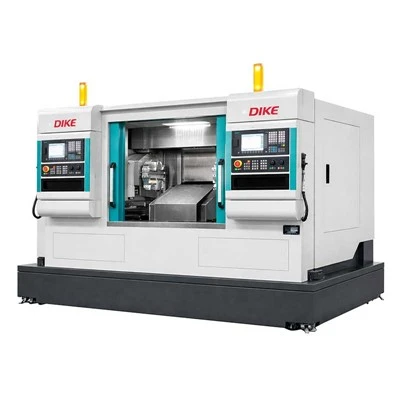
If you’re in the market for a double-spindle CNC lathe, or you’re thinking your current machine’s motors might be holding you back, reach out to us for a no-obligation chat. We can walk through your actual part specs, your production goals, and tell you exactly what motor setup you need, no pressure. We’re not here to sell you a 22kW spindle if a 12kW will work for your jobs.
Gear Skiving Machine References:
- Davis, J.R. (2010). Gear Materials: Principles and Applications. ASM International.
- Modern Machine Shop. (2022). “Motor Sizing for Multi-Spindle CNC Machining Operations.”
- Spindle Motor Technology Journal. (2021). “Continuous vs. Peak Power: Key Differences for Industrial Machining.”
- Machining Data Handbook. (2019). “Double-Spindle Lathe Performance Optimization.”
Wuxi DIKE CNC Technology Co., Ltd.
As one of the most professional double-spindle CNC lathe manufacturers and suppliers in China, we have world-leading production equipment and strong manufacturing capabilities. Please feel free to buy customized double-spindle CNC lathe at competitive price from our factory. Also, pricelist is available.
Address: No. 2, Xianshan Road, Qianqiao Street, Huishan District, Wuxi City, Jiangsu Province, China
E-mail: wxdk@wxdike.com
WebSite: https://www.dike-cnc.com/
