As someone who’s spent the better part of a decade working with titanium discs—from forging raw ingots for aerospace components to shipping polished blanks for medical device prototypes—I’ve learned that the right coating can turn a versatile material into a specialized workhorse. Titanium itself is incredible: it’s strong, lightweight, naturally corrosion-resistant thanks to that thin, self-healing oxide layer that forms on its surface when exposed to air. But even titanium has limits, depending on what it’s going to be used for. Let me walk you through the most common coatings we apply to our titanium discs, why we choose each one, and which industries they serve best—stuff I’ve picked up from years of field calls, lab tests, and conversations with engineers who know their way around metal finishing. Titanium Disc

First, let’s get one thing straight: titanium discs are rarely used uncoated for long-term, high-stakes applications. That thin native oxide layer is great for general use, but it’s porous enough to let contaminants seep in in harsh environments, and it can wear down or react with certain chemicals. Coating is also where you tailor a disc for a specific job: a disc for a surgical hip implant needs biocompatibility that goes beyond the base metal, while a disc for a oil and gas valve needs to handle brine and hydrogen sulfide without corroding.
Let’s start with the most widely used coating in our shop right now: anodized oxide coatings. You’ve probably heard of anodizing before—it’s not just for aluminum, after all. For titanium, the process works by immersing the disc in an electrolytic solution, then running a current through it to thicken that natural oxide layer. What makes this coating useful is two-fold: it’s extremely durable, and we can adjust its thickness by changing the voltage. A low-voltage anodize (10 to 50 volts) gives a thin, 0.1 to 1 micrometer layer that’s perfect for decorative uses—think aerospace interior panels or custom jewelry blanks. But bump that up to 100 to 200 volts, and you get a 5 to 20 micrometer thick layer that’s hard enough to resist scratching, corrosion, and even mild chemical exposure. I worked with a hydraulic systems engineer last year who needed titanium discs for a jet engine control valve; he went with a 150-volt anodize because it had to handle repeated motion and saltwater spray during test flights. One thing to note: anodized titanium is still highly biocompatible, so it’s also used for dental implant discs. We test every anodized disc in our in-house lab to make sure the oxide layer is uniform—no pinholes, no uneven thickness—because a flaw there can lead to corrosion down the line.
Next up, hard chrome plating. Wait, I know what you’re thinking—chrome plating is for cars and old furniture, but it’s actually one of the most reliable wear-resistant coatings we apply to titanium discs. The process here is a bit trickier than anodizing, because titanium’s native oxide layer makes it hard to get chrome to adhere. We have to do a pre-treatment: etching the surface in a hydrofluoric acid solution to knock off that thin oxide layer, then applying a strike coat of nickel to act as a bonding agent. Once that’s done, we can plate on a 20 to 100 micrometer layer of hard chrome. The result is a surface that’s super hard—Rockwell C hardness of 70 to 75, which is harder than most tool steels. That makes it ideal for parts that slide against other metal: pump components, hydraulic cylinders, gear discs for heavy machinery. Last year, a mining equipment supplier ordered 500 titanium discs coated with hard chrome for their slurry pumps; they told me the discs outperformed stainless steel ones by three times, because the chrome layer resisted wear from abrasive rock particles. The catch here? Hard chrome is a hexavalent chromium process, which is regulated in a lot of places for environmental reasons. We use non-toxic trivalent chrome alternatives now for most of our customers, which works just as well for non-medical applications.
Then there’s PVD coatings—physical vapor deposition, which has blown up in the last 15 years, especially for medical and consumer electronics parts. PVD works by heating a solid material (like titanium nitride, or titanium carbide) in a vacuum chamber until it vaporizes, then letting the vapor condense onto the titanium disc’s surface. The coating thickness here is super thin—usually 1 to 5 micrometers—but the properties are unmatched for specific uses. Titanium nitride (TiN) is the gold standard for cutting tool discs: it’s hard, has a low coefficient of friction, and that gold color is a nice bonus for decorative parts too. We’ve shipped TiN-coated titanium discs to a company that makes surgical scalpels; the coating stays sharp 30% longer than uncoated steel, which saves them money on replacement tools. For medical implants, we often use PVD of titanium oxide or zirconium oxide—these are bioinert, meaning they don’t trigger an immune response when they’re in contact with bone or tissue. A orthopedic surgeon client of ours uses zirconium oxide-coated titanium discs for knee replacement trial parts; they said the surface is smooth enough that bone cells adhere to it perfectly, without the risk of metal leaching. PVD is also great for electronic components: a lot of our semiconductor customers use PVD-coated titanium discs as sputtering targets, because the thin coating ensures consistent material deposition on silicon wafers. The downside of PVD? It’s more expensive than anodizing or chrome plating, and the coating is only as good as the surface prep—if a disc has even a tiny scratch before PVD, the coating will crack there. We sand and polish every PVD-bound disc three times before coating to avoid that.
Now, let’s talk about fluoropolymer coatings, like Teflon. These are for when you need something non-stick or highly corrosion-resistant in a very specific way—think food processing equipment or chemical handling parts. Fluoropolymers are applied as a liquid spray, then cured in an oven at around 400 degrees Celsius. The result is a thin, 10 to 50 micrometer layer that’s almost completely inert to chemicals, and has a super low friction coefficient. We did a job a couple years back for a craft brewery that needed titanium discs for their mash filter system; they were having issues with stainless steel discs sticking to the grain during filtration, which slowed down their process. A fluoropolymer coating fixed that—no more grain sticking, and the disc didn’t react with the acidic beer wort. That said, fluoropolymers aren’t the best for high-wear applications. The coating can scratch off if two metals rub against each other, so we only recommend it for parts that don’t see a lot of repeated contact. Also, it’s not biocompatible, so it’s never used in medical parts.
Last, but not least, ceramic coatings. I know, I mentioned oxide layers earlier, but ceramic coatings are thicker, engineered materials—usually aluminum oxide or silicon carbide—applied to titanium discs for extreme heat and corrosion resistance. These are used in aerospace and defense applications, where discs might be exposed to temperatures of 1,000 degrees Celsius or more. The process is usually plasma spraying: we heat the ceramic material to a molten state, then spray it onto the disc’s surface at high speed. The coating forms a rough, porous layer that can be sealed with a glaze if needed, to make it impermeable. We supplied ceramic-coated titanium discs to a satellite manufacturer a few years ago; the discs are part of the satellite’s heat shield, and they’ve to survive the extreme temperatures of space, from -150 degrees Celsius in shadow to 1,200 degrees Celsius when facing the sun. The ceramic coating has held up perfectly through three launches and two years in orbit. The drawback here is that ceramic coatings are brittle—they can crack if the disc is dropped or experiences mechanical shock—so they’re only used in static parts, not moving components.
Over the years, I’ve learned that the best coating isn’t just the one with the best properties—it’s the one that fits the application. A customer might come in asking for a “hard coating” for a disc, but if their part is for a food processing line, fluoropolymer is a better fit than hard chrome. If they need a hip implant disc, an anodize or PVD bioinert coating is non-negotiable, because biocompatibility can’t be compromised. That’s why we don’t just apply coatings—we work with our customers to test their specs, run small trial batches, and adjust the coating parameters until it’s exactly what they need.
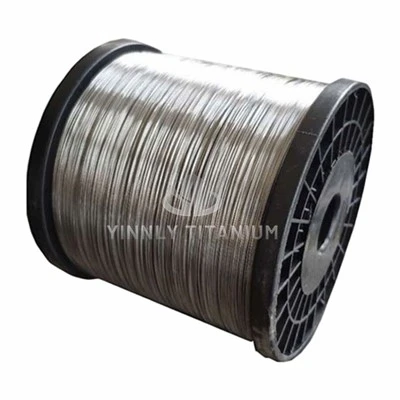
If you’re working on a project where you need titanium discs, or you’re not sure what coating is right for your application, we’re here to help. We can supply raw, polished, or pre-coated discs in custom sizes, and our team has decades of experience in metal finishing to guide you through every step. Don’t hesitate to reach out to start a conversation about your project—whether it’s a small prototype order or a large production run, we’re ready to deliver.
Titanium Ring References
- Chemical Processing of Titanium Alloys, American Society for Metals, 2010.
- Anodizing of Titanium: Process, Properties, and Applications, Journal of Materials Processing Technology, Vol. 195, 2008.
- Physical Vapor Deposition of Ceramic Coatings for Aerospace Components, Elsevier, 2015.
- Biocompatible Coatings for Titanium Implants, Biomaterials Science, Vol. 3, No. 4, 2015.
- Fluoropolymer Coatings for Industrial Applications, Society of Plastics Engineers, 2012.
Baoji Yinnly Titanium Co., Ltd.
Baoji Yinnly Titanium Co., Ltd. is one of the most professional titanium disc manufacturers and suppliers in China, featured by quality products and good service. Please rest assured to buy bulk titanium disc in stock here and get quotation from our factory. Customized orders are welcome.
Address: Unit 902, Building 1, Creative Building, No. 195, Gaoxin Avenue, High-tech Zone, Baoji City, Shaanxi Province
E-mail: anna@yinnlyti.com
WebSite: https://www.yinnlyti.com/
